( Update: 25/09/2014 )
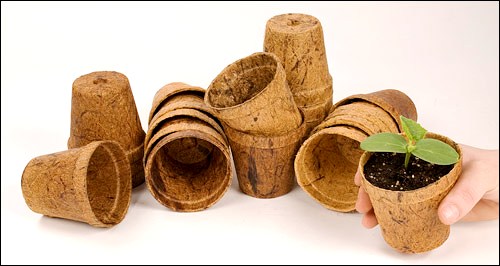 The garden industry is going green! That may seem like an oxymoron, but one of the biggest trends in gardening is environmentally friendly gardening products. One of the hottest new things that gardeners will have noticed this spring are pots made from coconut husk fibers. A number of single transplants at garden centers this spring are being sold in these natural fiber pots instead of plastic ones. Frugal gardeners have often reused some of the plastic pots left over after planting their gardens, but the great numbers of pots that accumulate from year to year has too often resulted in a lot of pots going to the landfill since recycling wasn’t available.
The use of natural plant fibers to make pots is not a new idea. Many of us are familiar with pots made from peat moss. However, the gardening world has become aware that the use of peat is not is not a sustainable practice. Peat moss comes from bogs or wetlands. The Canadian peat moss industry has been harvesting peat from bogs faster than the peat regenerates. This threatens the ecology of the peatlands and reduces their ability to store and filter fresh water, plus peat extraction and the use of peat moss releases carbon dioxide into the atmosphere.
In the United Kingdom, the Royal Horticultural Society has taken steps to end its dependence on peat moss in growing media and soil amendments. They have declared that 90% of its growing media will be peat free by 2010 and that the use of peat as a primary soil amendment or for mulching is not acceptable.
While no such declaration has been made in the U.S., I suspect economics has had a big part in pushing peat off the garden store shelves here. Peat has become increasingly expensive and as a result, many potting soil companies have been looking for lower cost substitutes. In fact, it’s hard to find a potting soil containing much peat moss. Most contain varying amounts of compost, shredded bark, and other organic ingredients. In addition, with continually increasing oil prices, the price of plastic pots has been on the rise for a long time. The time has certainly come for natural fiber pots that aren’t made from peat.
This year I purchased some tomato transplants that were grown in pots made from coconut coir. I have talked about coir before as a new alternative to peat moss for use in potting mixes and for amending soils. Coir (pronounced "koi'er") is a byproduct of the Southeast Asian coconut processing industry. It comes from the husk around the coconut. In the past, the long fibers of coconut husks were used to make things like doormats, rope, furniture stuffing, and more, but the short fibers or "dust" didn’t have a use and was left to sit in large piles. Now , university researchers and gardeners are finding that coir short fibers performs as well as peat, if not even a little better, in potting mixes and as a soil amendment.
This year was the first time I saw and experienced coconut coir pots. The pots are made from coir fiber bound together with natural latex. Since the sides of the pots are porous they allow for air to get to roots, but the potting soil also dries out more quickly because of this. Not a problem, gardeners just need to make sure they don’t dry out before planting in the garden.
Manufacturers recommend planting transplants with the plants still in the pots, but I’m not sure that’s a good idea. They indicate that the pots will decompose within three months when in the soil, but for our annual flower and vegetable transplants even three months can be limiting. I’m also willing to bet that they won’t break down even within six months in our local climate and soils, just like peat pots had a tendency to break down slowly and restrict root growth.
With that in mind, I didn’t plant my tomatoes transplants with the coconut coir pots left on the roots. I decided to take the transplants out of these pots, but they didn’t slip out easily as often happens with plastic pots. Pulling didn’t work either because the roots had grown into the fibers. The pot fibers were so strong that I couldn’t even easily tear cut or the pot off. To remove the plants, I used a trowel to sever roots and loosen the plants from the pots. The plants were extremely healthy before taking them out of their pots and they have continued to thrive after planting.
It’s my opinion that coconut coir pots have the potential to provide us with healthier transplants with healthier roots systems, but gardeners and growers will need to take care in not letting them become drought stressed before planting and not to let them stay in the pots too long resulting in roots growing through the fibers.
Written by Marianne C. Ophardt - WSU Extension Faculty


Online: 30
Visit counter : 4557015
Copyright © 2012 by hxcoexp.com - All right reserved
Designed by OSG.VN